


Parents' phone habits may influence how children experience connection, attention and emotional...

In 2024, Bridgeton resident Destinay Erbie had every reason to feel hopeful. After years of fertility treatments, she was finally pregnant. But the joy arrived alongside a wave of upheaval. About two weeks before her positive pregnancy test, she had given notice at a job she held for seven years. Leaving the comfort and stability of a longtime role to then find out she was finally pregnant marked the beginning of an intense emotional period. Then, just two months into her new job, she realized it wasn’t the right fit and resigned, leaving her unemployed, pregnant and facing a future that felt anything but steady.
"I had all these things going on at one time," she said. "I knew I had a baby coming. I had no income. And that's where it really started."
Destinay, who has a background in social work and psychology, understood mental health in a professional context. But she had never heard of perinatal mental health care, the specialized care that addresses the emotional and psychological needs of people before, during and after pregnancy, across their entire reproductive journey. That changed at a routine prenatal appointment.
During a prenatal check-in, Destinay completed the Edinburgh Postnatal Depression Scale, a standard screening tool used to identify symptoms of depression and anxiety during and after pregnancy. Her score was well above the threshold that signals a need for further support.
What happened next moved quickly. Her midwife, Miriam Rosetti, C.N.M., coordinated a referral to Inspira Health's Perinatal Mental Health Services in Bridgeton. In just over a week, Destinay was connected with Allison Lant, L.C.S.W., PMH-C, a licensed clinical social worker and co-founder of the program. She had her intake appointment on Nov. 13, 2024, about a week after the referral was placed.
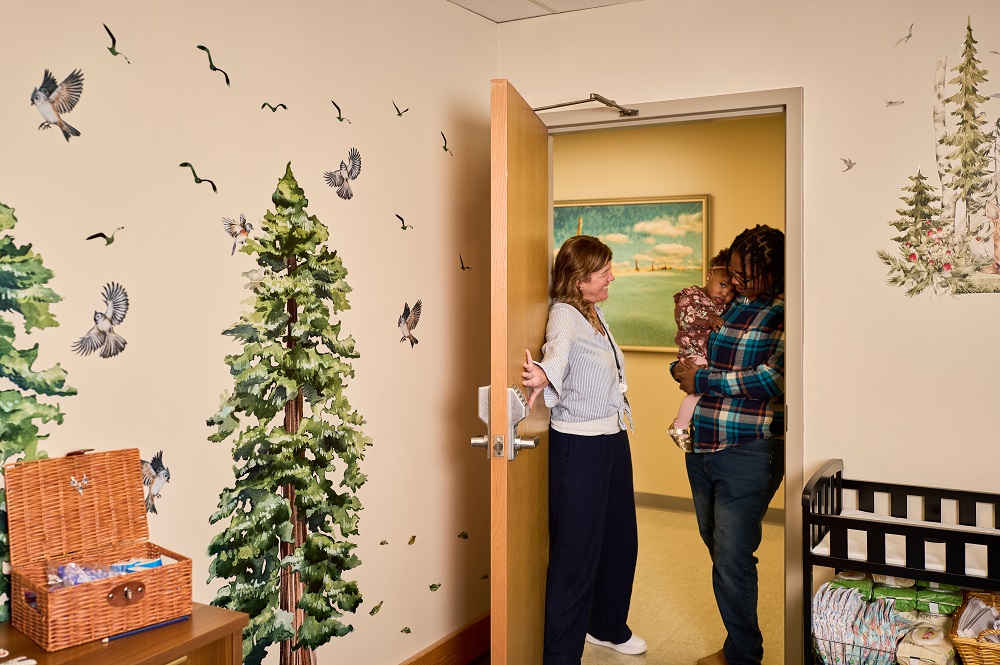
Inspira's Perinatal Mental Health Services was built by clinicians who recognized a gap. Allison Lant and colleague Susan Gonzalez, L.C.S.W., PMH-C, saw firsthand that pregnant people and new parents needed more than a referral to a general therapist.
"A lot of people wanted therapy," Lant said. "They wanted to be able to talk to someone, but they never had the opportunity. And it's different when you're pregnant, when you're postpartum."
The program now includes six trained therapists, two advanced practice nurses who can prescribe medication, a baby-friendly space with changing tables and rocking chairs and the option to be seen in person or via telemedicine. Referrals come directly from OB/GYNs, midwives and inpatient social workers across Inspira's network.
"We want people to know that the support is here," Gonzalez said. "Mental health care should be part of perinatal health care, and it should be available to everyone."
The program supports patients across the full reproductive journey, including those navigating fertility challenges, pregnancy loss and the transition into parenthood. "There's no judgment about any of it," Lant said. "What happens all along their entire journey matters."
Destinay began seeing Lant at 28 weeks pregnant. She was already working with a therapist virtually, but she stayed with Lant. The relationship was different.
"It's nice that Allison understands it from the perspective of motherhood and having a small child," Destinay said. "There's no judgment about how I chose to become a mother, about fertility, about any of it."
That level of acceptance didn't feel designed or mandated. It felt personal. "I can tell that is how she is as a person," she said. "It's not just because she has to be that way as a clinician."
For Destinay, in-person sessions have always been the preference. She values physical presence in a way that telehealth cannot replicate. "I'm big on relationships," she said. "You just can't connect with people the same way over the phone or over video."
Lant has been there for every chapter. She saw Destinay through pregnancy, the newborn stage, the return to work, the hard early months of sleep deprivation and the slow, uneven climb toward confidence as a new mother. Now Destinay's daughter Ziah is 15 months old. She’s sassy, social and, in Destinay's words, "a piece of work." Lant, she jokes, seems to love Ziah nearly as much as she does.
"She saw me at my lowest," Destinay said. "And then she saw me get back into work, have the baby, go on maternity leave and go back to work. She's been there. I'm grateful she got to see me in all my stages."
One of the unexpected gifts of therapy, Destinay said, has been perspective. As a single mother navigating social media, she found herself caught up in comparisons to the elaborate monthly milestone photos and perfectly curated posts from other parents. But working with Lant helped her step back from the noise.
During the same stretch, Destinay also became a homeowner. "Allison said it's a testament to just how capable I really am,” Destinay said. “I bought a house. I'm making more money than I was in 2024. Those are the things that really matter.”
Therapy also helped Destinay manage her triggers and reactions as a parent. She learned to recognize when to step back and understand the difference between a feeling and a response. "You have to be aware of your warning signs," she said. "When you need to take a break. It's okay. And Allison reminds me that it's okay to be frustrated with your children. A lot of parents won't admit it. I will."
For Destinay, the parallel between physical and mental health care is straightforward. Her background in social work shaped that view, but so did her lived experience. "Mental health is right up there with going to your primary care doctor," she said.
Lant echoes that sentiment. The program's goal, she said, has always been to make care feel accessible and free of stigma. “When they can start to have self-compassion, that's when they start to trust themselves and say, “Wait. I'm a good mom. I can do this.’”
Destinay is proof of that. She walked into Lant's office pregnant and uncertain, navigating more change than most people face in a decade. She walks in now with a 15-month-old who marches straight up to strangers and says hello. "It was an easy process to get started," Destinay said. "I don't think there's any reason why anyone shouldn't give it a try."
Inspira Health's Perinatal Mental Health Services supports pregnant people and new parents at all stages of the reproductive journey, including pregnancy, postpartum, pregnancy loss and fertility challenges. Care is available in person and via telemedicine. Learn more about the program here.

Parents' phone habits may influence how children experience connection, attention and emotional...

Prenatal appointments are one of the most important parts of a healthy pregnancy, and a little...

Inspira Health's expanded maternity unit at Inspira Medical Center Mullica Hill is now open...